
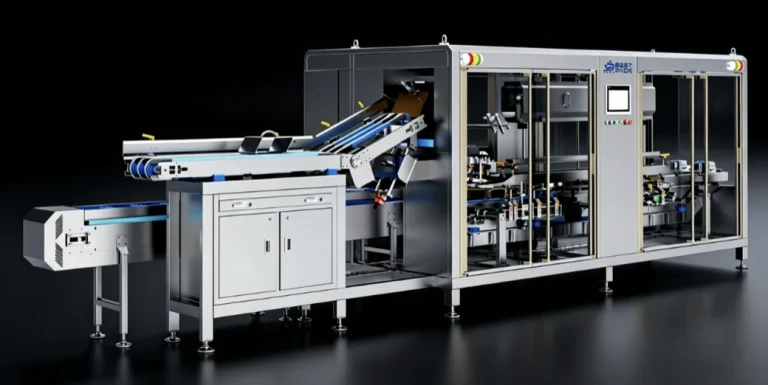
The Changing Requirements of Convenience Food Packaging
The fresh and convenience food market is becoming increasingly diverse. Ready meals, prepared foods, fresh produce, chilled products, and meal kits are being developed in more package formats to meet changing consumer preferences.
At the same time, food manufacturers need to maintain production efficiency while controlling packaging costs and meeting increasingly demanding hygiene and quality requirements.
This has increased interest in automated form-load-seal systems, which combine several packaging operations into a coordinated production process.
Rather than relying on separate machines for forming, loading, and sealing, an integrated system can streamline these stages and create a more efficient packaging workflow.
What Is a Form-Load-Seal System?
A form-load-seal system is an automated packaging solution that combines package forming, product loading, and sealing within one coordinated process.
Depending on the application, the packaging material may be formed into a tray, pouch, carton, or other predefined format before the product is loaded and the package is sealed.
The basic workflow can include:
Package Forming
Packaging material is automatically shaped according to the required format.
Product Loading
Products are accurately transferred into the formed package.
Sealing
The package is securely closed to protect its contents.
Inspection and Discharge
Finished packages can be checked and transferred to downstream packaging equipment.
This integrated approach reduces unnecessary manual handling between individual processes.
Applications in Fresh & Convenience Foods
Ready Meals
Ready-to-eat meals often require efficient packaging systems capable of handling different recipes and package sizes.
Fresh Produce
Fresh-cut vegetables, salads, and prepared fruit require hygienic and consistent packaging processes.
Chilled Foods
Prepared meat, seafood, and other chilled products can benefit from automated loading and sealing.
Meal Kits
As meal delivery and prepared meal services continue to develop, flexible packaging automation becomes increasingly important.
Why Manufacturers Choose Form-Load-Seal Automation
Fewer Manual Operations
Combining multiple processes reduces the need for manual product transfer.
Consistent Packaging
Automated forming and sealing provide greater consistency between packages.
Improved Production Efficiency
Integrated operations can reduce unnecessary movement and production bottlenecks.
Flexible Product Handling
Customized systems can be designed around different product characteristics and packaging formats.
Hygiene and Product Handling Considerations
Fresh and convenience foods often have strict requirements for hygiene and product handling.
An automated system can help manufacturers reduce unnecessary human contact during packaging.
The equipment can also be configured around:
- Product characteristics
- Production environment
- Cleaning requirements
- Packaging material
- Target production capacity
This makes equipment selection an important part of the overall packaging project.
Flexible Production for Multiple SKUs
Food manufacturers rarely produce only one product.
A modern production facility may need to package different:
- Product weights
- Package dimensions
- Recipes
- Retail formats
- Promotional combinations
An appropriately configured form-load-seal system can support multiple packaging specifications while reducing changeover time.
This flexibility is particularly valuable for manufacturers that frequently introduce new products or operate multiple SKUs on the same production line.
Integration with End-of-Line Automation
Form-load-seal equipment can also serve as part of a complete automated packaging line.
Finished packages can be transferred to:
- Checkweighers
- Cartoning machines
- Case packers
- Shrink wrapping machines
- Case sealers
- Palletizing systems
With appropriate line integration, manufacturers can connect primary and secondary packaging processes into a continuous workflow.
Choosing a Form-Load-Seal Machine Manufacturer
The right equipment depends heavily on the application.
Manufacturers should consider:
Product Characteristics
Size, shape, weight, viscosity, and handling sensitivity can all influence machine configuration.
Packaging Materials
Different films, cartons, trays, and other materials require different forming and sealing technologies.
Production Capacity
The equipment should match both current production requirements and future expansion plans.
Factory Layout
Line footprint, product flow, operator access, and maintenance space should be considered during project planning.
Customization
A standard machine may not always provide the most efficient solution. Customized automation can be more appropriate for specialized production conditions.
The Future of Automated Food Packaging
Food packaging is moving toward greater flexibility, connectivity, and automation.
Manufacturers are increasingly looking for systems that can provide:
- Faster changeovers
- Lower labor requirements
- Better production monitoring
- Greater packaging consistency
- Compatibility with sustainable materials
For fresh and convenience food producers, these capabilities can help build packaging operations that are better prepared for changing market requirements.
Conclusion
Automated form-load-seal systems provide fresh and convenience food manufacturers with an integrated approach to packaging. By combining forming, loading, and sealing operations, they can simplify production processes, improve consistency, and reduce manual handling.
For manufacturers with complex products or multiple packaging formats, a customized form-load-seal solution can provide a practical foundation for building a more flexible and efficient automated packaging line.