
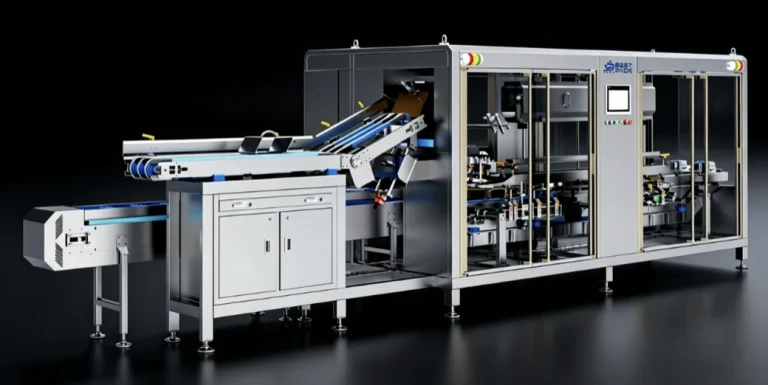
Why Case Forming Matters in Food Packaging
As food manufacturers continue to increase production capacity and automate their operations, packaging efficiency has become just as important as product quality.
While much attention is often given to filling, weighing, sealing, and cartoning equipment, case forming is a critical step that directly impacts downstream packaging performance. If shipping cases are not erected accurately and consistently, the entire packaging line can experience delays, jams, and unnecessary downtime.
This is why many food producers are investing in automatic case formers to create a reliable foundation for automated end-of-line packaging.
What Is an Automatic Case Former?
An automatic case former is a packaging machine designed to automatically erect corrugated cartons, fold the bottom flaps, and seal the case before it enters the packing station.
The process generally includes:
Case Magazine Loading
Flat carton blanks are loaded into the machine magazine.
Automatic Carton Picking
The machine separates and picks individual carton blanks.
Carton Erection
The carton is opened and formed into its final shape.
Bottom Flap Folding and Sealing
The bottom flaps are folded and sealed automatically using tape or hot melt adhesive.
Ready for Product Loading
The completed case is transferred to the next packaging station.
This fully automated process eliminates manual carton assembly and ensures consistent case quality.
Applications Across Food Industries
Bakery Products
Automatic case formers are widely used for:
- Bread packaging
- Biscuit packaging
- Cake packaging
- Snack packaging
Reliable carton formation ensures smooth case packing operations.
Fresh & Convenience Foods
Ready meals, frozen foods, and prepared foods often require high-volume secondary packaging.
Pasta and Milling Products
Manufacturers packaging flour, pasta, grains, and dry food products benefit from automated case preparation.
Confectionery Products
Chocolate, candy, and snack producers use case formers to support high-speed packaging lines.
Benefits of Automatic Case Forming Machines
Increased Production Efficiency
Automated case erection eliminates manual carton assembly and reduces bottlenecks.
Consistent Case Quality
Every carton is formed according to the same specifications.
Reduced Labor Costs
Automation minimizes operator involvement and repetitive manual tasks.
Improved Packaging Line Stability
Uniform cases reduce disruptions during loading and sealing operations.
Supporting Fully Automated Packaging Systems
Modern food manufacturers are increasingly implementing complete end-of-line automation.
Automatic case formers integrate seamlessly with:
Automatic Cartoners
Products packed into cartons can move directly to case packing stations.
Side Loading Case Packers
Pre-formed cases are delivered automatically for loading.
Top Loading Case Packers
Case formers provide consistent cartons for robotic loading systems.
Palletizing Equipment
Cases continue through the packaging process without manual intervention.
Why Food Manufacturers Choose Automatic Case Formers
Reliable Operation
Food production often operates multiple shifts, requiring dependable equipment.
Fast Changeovers
Modern machines support multiple carton sizes with minimal adjustment time.
Flexible Packaging Options
Case formers accommodate a wide range of carton dimensions.
Scalable Production Capacity
Equipment can grow alongside production demands.
Industry 4.0 and Smart Packaging Automation
Today’s packaging equipment is becoming increasingly intelligent.
Modern automatic case formers offer:
Real-Time Performance Monitoring
Operators can monitor machine status continuously.
Production Data Collection
Performance metrics support operational improvements.
Fault Detection Systems
Automatic diagnostics reduce troubleshooting time.
Remote Service Capabilities
Technical support teams can assist remotely when necessary.
Sustainability Benefits of Automated Case Forming
Sustainable packaging is becoming a priority for food manufacturers worldwide.
Automatic case formers contribute by:
Reducing Material Waste
Accurate carton forming minimizes damaged cartons.
Supporting Recyclable Packaging
Corrugated cartons remain one of the most sustainable packaging formats.
Improving Transportation Efficiency
Consistent carton dimensions optimize pallet utilization.
Lowering Product Damage Rates
Properly formed cases provide better product protection during logistics.
Choosing the Right Automatic Case Former Manufacturer
Selecting the appropriate supplier requires careful evaluation.
Machine Reliability
The equipment should support long production cycles with minimal downtime.
Carton Size Flexibility
Future product expansion may require additional carton formats.
Integration Capability
The machine should work seamlessly with existing packaging systems.
Technical Support
Reliable after-sales service is essential for maintaining productivity.
Future Trends in Food End-of-Line Packaging
Several trends continue to shape packaging automation.
Fully Automated Packaging Lines
Manufacturers are reducing manual handling throughout the production process.
Robotics Integration
Case formers increasingly work alongside robotic packing systems.
Sustainable Packaging Materials
Packaging equipment must accommodate evolving carton designs and eco-friendly materials.
Smart Factory Connectivity
Machines are becoming fully connected components within digital manufacturing environments.
Conclusion
Automatic case formers play a crucial role in modern food packaging lines. By automating carton erection, improving packaging consistency, and supporting downstream automation, these machines help food manufacturers increase efficiency while reducing labor costs.
For companies seeking reliable end-of-line packaging solutions, investing in an automatic case former provides a strong foundation for long-term productivity, scalability, and operational excellence.