
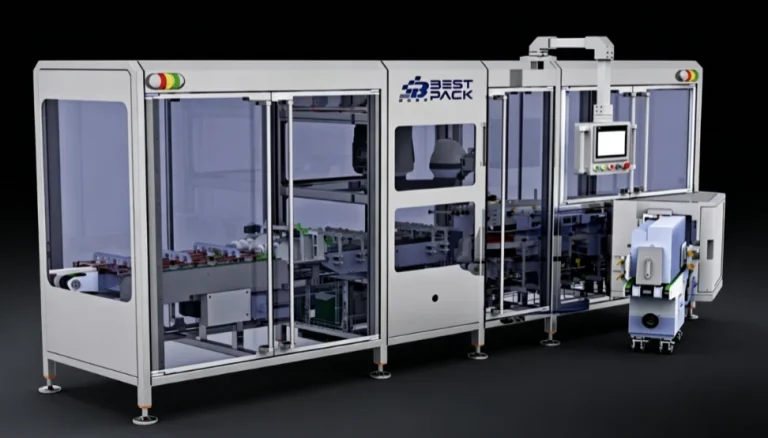
Why Secondary Packaging Matters in Beverage Production
The beverage industry relies heavily on efficient secondary packaging systems to ensure products reach distributors, retailers, and consumers safely.
Whether packaging bottled water, soft drinks, energy drinks, juices, or dairy beverages, manufacturers must manage high production volumes while maintaining packaging stability and logistics efficiency.
As production speeds continue to increase, manual case packing becomes inefficient and costly. This has led many manufacturers to adopt top loading case packers for beverage packaging lines.
These automated systems improve packaging consistency while reducing labor requirements and operational costs.
What Is a Top Loading Case Packer?
A top loading case packer is a packaging machine that loads products vertically into open shipping cases from above.
The process typically includes:
Product Grouping
Products are automatically arranged into predefined pack patterns.
Case Forming
Corrugated cases are erected and positioned for loading.
Product Loading
Products are lowered into the case using robotic or servo-controlled systems.
Case Discharge
Filled cases move to sealing and palletizing stations.
This method provides gentle handling while maintaining high packaging accuracy.
Benefits of Top Loading Case Packers
Gentle Product Handling
Beverage containers can be sensitive to impact during packaging.
Top loading systems minimize product movement and reduce the risk of damage.
Packaging Flexibility
Manufacturers can package:
- PET bottles
- Glass bottles
- Aluminum cans
- Beverage cartons
using a single automated solution.
Fast Product Changeovers
Modern servo-driven equipment allows operators to switch between package formats quickly.
Improved Packaging Quality
Consistent loading patterns improve case stability during transportation and storage.
Beverage Applications
Bottled Water Packaging
Top loading case packers are widely used for:
- 6-pack cartons
- 12-pack cartons
- Retail-ready cases
Soft Drink Production
Manufacturers benefit from high-speed automated loading for both bottles and cans.
Juice Packaging
Juice bottles and cartons require accurate loading to prevent transportation damage.
Dairy Beverage Packaging
Milk drinks and nutritional beverages often use top loading systems for reliable secondary packaging.
Integration with Beverage Packaging Equipment
Top loading case packers are commonly integrated with:
Upstream Equipment
- Filling machines
- Labeling systems
- Shrink wrapping machines
- Sleeve wrappers
Downstream Equipment
- Case sealers
- Checkweighers
- Robotic palletizers
- Warehouse automation systems
This integration creates a complete end-of-line packaging solution.
Top Loading vs Side Loading Case Packers
Top Loading Advantages
- Greater packaging flexibility
- Better handling of fragile products
- Easier adaptation to multiple package formats
Side Loading Advantages
- Higher speed in some applications
- Compact machine footprint
- Ideal for uniform product sizes
For beverage manufacturers producing multiple package types, top loading systems often provide greater operational flexibility.
Industry Trends in Beverage Secondary Packaging
Several trends continue to drive demand for automated case packing solutions:
Rising Labor Costs
Automation helps reduce labor dependency and improve productivity.
Sustainability Initiatives
Manufacturers seek packaging systems that support recyclable materials and optimized carton usage.
Production Flexibility
Frequent product launches require equipment capable of fast format changes.
Smart Manufacturing
Industry 4.0 technologies provide real-time monitoring and predictive maintenance capabilities.
Choosing the Right Beverage Case Packer
Before selecting a case packing solution, manufacturers should consider:
- Product dimensions
- Case sizes
- Required production speed
- Available floor space
- Future expansion requirements
A reliable beverage packaging machinery manufacturer can provide customized solutions tailored to specific production needs.
Conclusion
Top loading case packers have become an essential component of modern beverage packaging lines. By improving efficiency, reducing labor costs, and enhancing packaging consistency, these systems help beverage manufacturers optimize secondary packaging operations while preparing for future growth.