
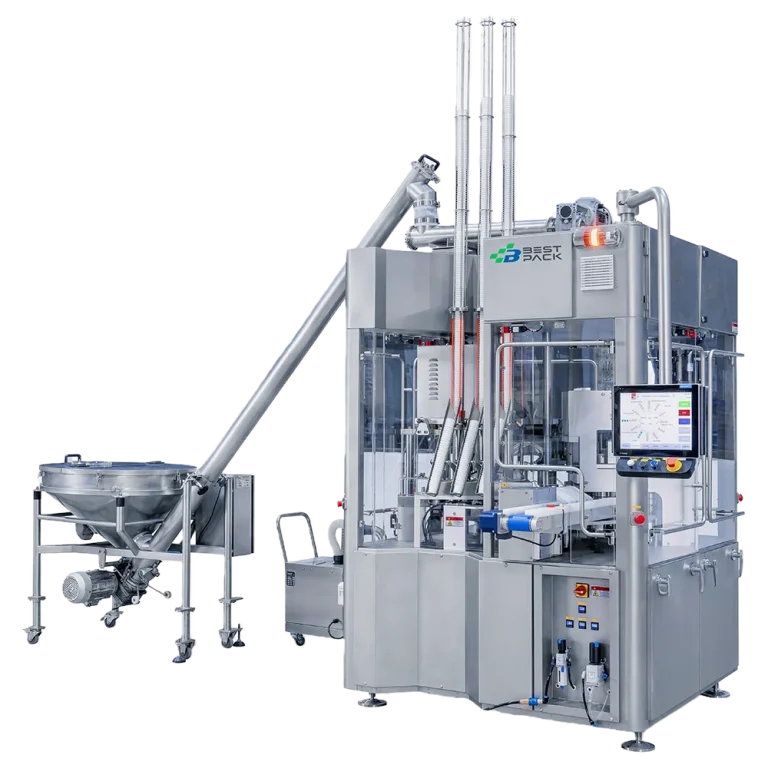
Efficient Case Packing for Dry Food Products
Pasta, bakery products, flour, grains, and other milling products are produced in a wide range of packaging formats. Although the products themselves may differ considerably, many manufacturers face a similar challenge at the end of the packaging line: how to efficiently load finished retail packages into shipping cases.
Manual case packing can become difficult as production volumes increase. Repetitive handling also creates additional labor requirements and may lead to inconsistent case arrangements.
For these applications, top loading case packers offer an efficient method of automatically arranging products and loading them into cases from above.
What Is a Top Loading Case Packer?
A top loading case packer is an automated machine that groups products into predetermined patterns and places them vertically into an open case.
Compared with side loading systems, top loading technology provides a different approach to product handling and can be particularly useful for products that are stable when handled from above.
A typical process includes:
Product Infeed
Finished products enter the case packing system.
Product Collation
Packages are grouped according to the required case pattern.
Case Preparation
An open case is positioned beneath the loading area.
Top Loading
The grouped products are lowered into the case.
Case Closing
The filled case is transferred to a downstream sealing station.
Applications for Pasta Products
Pasta manufacturers commonly produce bags, boxes, and other retail packages in multiple sizes.
Top loading case packers can help organize these packages into stable shipping configurations.
Applications may include:
- Pasta bags
- Pasta cartons
- Specialty pasta products
- Multipack pasta products
Automation is especially useful for facilities operating high-volume production lines.
Applications for Bakery Products
Bakery packaging presents its own handling challenges because some products can be relatively delicate.
Top loading systems can be configured to handle suitable:
- Biscuit cartons
- Cookie packages
- Cracker packs
- Snack products
- Bakery gift packs
Proper product collation and controlled loading help reduce unnecessary manual handling.
Applications for Milling Products
The milling sector includes a wide variety of dry food products, such as flour, grains, cereals, and related products.
Depending on the package format, top loading case packers can be integrated into packaging lines handling:
- Flour bags
- Grain packages
- Cereal products
- Dry food cartons
For manufacturers operating multiple packaging formats, customized case packing configurations can provide additional flexibility.
Key Advantages of Top Loading Case Packers
Efficient Product Grouping
Automated collation creates consistent case patterns.
Reduced Manual Handling
Products are automatically transferred into shipping cases.
Consistent Case Utilization
Predefined loading patterns help optimize available case space.
Improved Production Efficiency
Automation allows the case packing process to keep pace with upstream packaging equipment.
Supporting Multiple Case Configurations
Food manufacturers may use different case sizes depending on their customers, distribution channels, and product types.
A flexible top loading system can be designed to accommodate different:
- Product dimensions
- Case sizes
- Loading patterns
- Pack quantities
This is particularly useful for companies serving multiple markets or producing private-label products.
Integration with a Complete Packaging Line
A top loading case packer rarely operates as an isolated machine.
It can be connected with upstream and downstream equipment, including:
Upstream
- Cartoning machines
- Flow wrapping machines
- Product sorting systems
- Checkweighers
- Accumulation conveyors
Downstream
- Case sealers
- Labeling systems
- Palletizers
- Stretch wrapping equipment
This creates a coordinated end-of-line packaging system from finished product to shipping pallet.
Automation and Labor Efficiency
Labor availability is an important consideration for food manufacturers in many markets.
Automating repetitive case packing operations allows operators to focus on machine supervision, quality checks, and other higher-value activities.
At the same time, automated loading provides greater consistency than manually placing products into cases, particularly during long production runs.
What to Consider Before Choosing a Top Loading Case Packer
Product Format
The size, weight, shape, and packaging material determine how products should be handled.
Required Throughput
The machine should be capable of matching the output of the upstream packaging line.
Case Dimensions
Different shipping cases may require different loading mechanisms.
Factory Space
The available footprint and product flow should be considered during line design.
Future Expansion
If new SKUs or higher production volumes are expected, the equipment should provide sufficient flexibility.
Customized Case Packing Solutions
There is no single case packing configuration suitable for every food manufacturer.
A customized solution can be designed according to:
- Product characteristics
- Case specifications
- Required production capacity
- Factory layout
- Packaging workflow
- Downstream logistics requirements
This approach allows the case packer to become part of a complete packaging strategy rather than functioning as an independent piece of equipment.
Conclusion
Top loading case packers provide pasta, bakery, and milling manufacturers with an efficient solution for automating secondary packaging. By automating product collation and case loading, these machines reduce manual handling, improve case consistency, and support higher production efficiency.
For food manufacturers looking to upgrade their end-of-line operations, a properly configured top loading case packing system can provide the flexibility and reliability needed for modern production environments.