
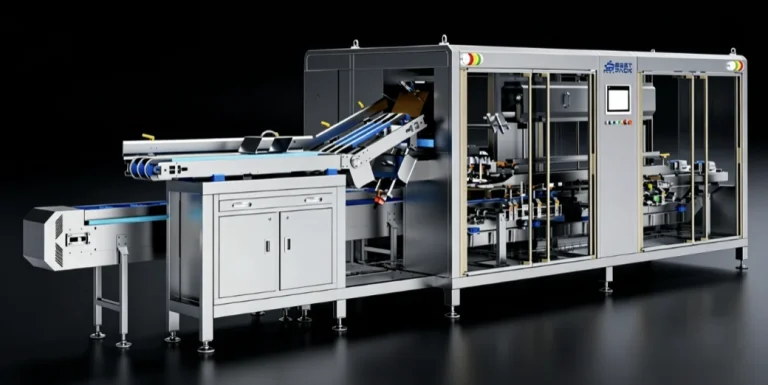
Understanding the Role of Case Packers in Modern Packaging Lines
As manufacturers continue to automate their production processes, secondary packaging has become an increasingly important stage in the packaging workflow. While primary packaging protects individual products, secondary packaging prepares products for storage, transportation, retail distribution, and palletizing.
One of the most widely used solutions in modern end-of-line packaging systems is the case packer. These machines automatically load products into corrugated cartons or shipping cases, significantly improving packaging efficiency while reducing labor requirements.
Among the available solutions, top loading case packers and side loading case packers are the two most common configurations. Understanding the differences between these technologies can help manufacturers select the most effective packaging solution for their operations.
What Is a Case Packer?
A case packer is an automated packaging machine designed to place products into shipping cartons or corrugated cases.
The system typically performs several tasks:
- Product grouping
- Product orientation
- Case forming
- Product loading
- Case sealing
- Quality inspection
Modern automatic case packing machines are commonly integrated with shrink wrapping equipment, cartoning machines, labeling systems, checkweighers, and palletizers to create complete secondary packaging lines.
As production speeds increase, case packers have become essential equipment in food, beverage, personal care, pharmaceutical, and consumer goods industries.
What Is a Top Loading Case Packer?
A top loading case packer inserts products vertically through the open top of a carton or shipping case.
The machine groups products and lowers them into the case using robotic grippers, servo-controlled systems, or mechanical pick-and-place devices.
Key Features of Top Loading Case Packers
- Flexible product handling
- Suitable for irregular product shapes
- Supports multiple package formats
- Easy integration with robotic systems
- Ideal for fragile products
Top loading systems are particularly useful when products require careful placement to avoid damage.
Common Applications for Top Loading Systems
Top loading case packers are frequently used in industries that require high flexibility and gentle product handling.
Typical applications include:
Food Industry
- Frozen foods
- Bakery products
- Snack foods
- Confectionery products
Beverage Industry
- Cartoned beverages
- Juice boxes
- Specialty drink packaging
Personal Care Industry
- Cosmetic products
- Toiletries
- Hygiene products
For manufacturers handling multiple product sizes and packaging formats, top loading equipment often provides greater versatility.
What Is a Side Loading Case Packer?
A side loading case packer loads products horizontally into a carton or shipping case.
Products are accumulated and pushed directly into the case from the side, creating a highly efficient packaging process.
Key Features of Side Loading Case Packers
- High-speed operation
- Excellent production efficiency
- Compact machine footprint
- Consistent product loading
- Suitable for uniform products
Because products are loaded horizontally, side loading systems are often selected for large-scale production environments.
Common Applications for Side Loading Systems
Side loading case packers are widely used in industries with stable, high-volume production.
Typical applications include:
Beverage Production
- Bottled water
- Soft drinks
- Energy drinks
- Canned beverages
Food Manufacturing
- Cereal boxes
- Packaged snacks
- Ready meals
Household Products
- Tissue boxes
- Cleaning products
- Detergent packaging
These systems are designed to maximize throughput while maintaining consistent package quality.
Comparing Top Loading and Side Loading Case Packers
Production Speed
Side loading systems generally achieve higher packaging speeds because products can be loaded continuously.
Top loading systems may operate at slightly lower speeds but offer superior flexibility.
Product Flexibility
Top loading equipment handles a wider variety of product shapes and dimensions.
Side loading equipment performs best with uniform products.
Changeover Efficiency
Top loading systems often support faster format changes, making them suitable for manufacturers with diverse product portfolios.
Space Requirements
Side loading machines typically occupy less floor space and fit well into compact production environments.
Integration with End-of-Line Packaging Systems
Today’s packaging facilities rarely operate individual machines independently.
Case packers are often integrated with:
Upstream Equipment
- Shrink wrapping machines
- Sleeve wrappers
- Cartoning systems
- Product conveyors
Downstream Equipment
- Case sealers
- Checkweighers
- Palletizing systems
- Warehouse automation systems
Integrating multiple machines into a complete packaging line improves efficiency and minimizes manual handling.
How to Choose the Right Case Packing Machine
Several factors should be evaluated before selecting a case packer.
Product Characteristics
Consider:
- Product dimensions
- Product weight
- Product fragility
- Packaging configuration
Production Requirements
Evaluate:
- Required output speed
- Number of shifts
- Future expansion plans
Packaging Formats
Different case styles may require different loading technologies.
Automation Goals
Manufacturers seeking fully automated packaging systems should consider integration capabilities when choosing equipment.
Working with an experienced packaging machinery supplier can help ensure the most appropriate solution is selected.
Future Trends in Case Packing Technology
Case packing technology continues to evolve as manufacturers pursue greater automation and efficiency.
Key developments include:
Robotic Case Packing
Advanced robotic systems provide greater flexibility and precision.
Smart Manufacturing
Digital monitoring systems allow operators to track machine performance in real time.
Sustainable Packaging
Modern case packers increasingly support recyclable and lightweight packaging materials.
Industry 4.0 Connectivity
Data-driven packaging systems improve productivity while reducing downtime.
Conclusion
Both top loading and side loading case packers offer significant advantages for secondary packaging operations.
Top loading systems provide exceptional flexibility and gentle product handling, while side loading systems deliver maximum throughput and efficiency for high-volume production.
By evaluating product characteristics, production requirements, and automation objectives, manufacturers can select the most suitable case packing solution for long-term success.