
The Growing Importance of Weight Accuracy in Food Packaging
In today’s highly competitive food manufacturing industry, product quality, consistency, and compliance are more important than ever. Consumers expect every package to contain exactly what is stated on the label, while regulatory authorities impose strict requirements regarding product weight accuracy.
Even small weight deviations can lead to customer complaints, regulatory penalties, product recalls, or significant financial losses due to product giveaway. As production volumes increase and packaging speeds become faster, manual weight inspection is no longer sufficient.
This is why more manufacturers are investing in online checkweigher systems. These automated inspection solutions continuously verify product weight during production, ensuring every package meets predefined specifications before reaching customers.
Modern food packaging lines increasingly rely on checkweigher technology to maintain quality standards, improve operational efficiency, and reduce production costs.
What Is an Online Checkweigher System?
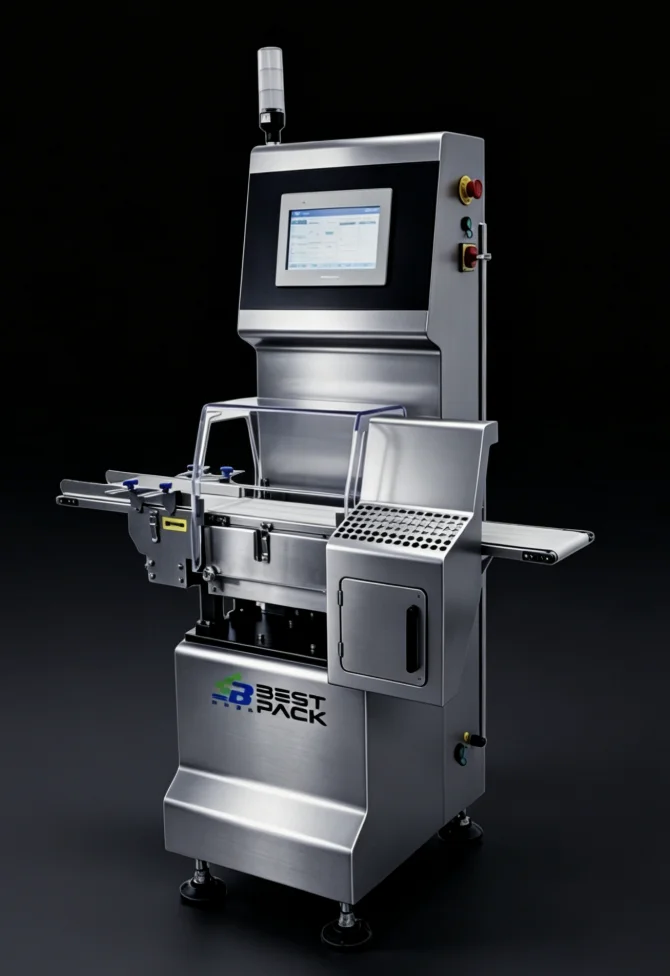
An online checkweigher is an automated weighing machine installed directly within a production or packaging line. Unlike static scales that require manual operation, checkweighers weigh products dynamically while they move along a conveyor.
The system automatically compares the measured weight against preset tolerances and identifies products that fall outside acceptable limits.
A typical checkweigher system includes:
- Infeed conveyor
- Weighing conveyor
- Discharge conveyor
- Load cell technology
- Product rejection device
- Data collection software
- User control interface
By performing continuous weight verification, checkweighers ensure that underweight and overweight products are detected before shipment.
Why Weight Control Matters in Food Manufacturing
Weight control is one of the most critical quality indicators in food production.
Regulatory Compliance
Most countries enforce strict regulations regarding packaged food weights. Manufacturers must ensure that products comply with declared net weight requirements.
Failure to meet these requirements can result in:
- Regulatory fines
- Product recalls
- Brand reputation damage
- Legal liabilities
Online checkweigher systems help manufacturers maintain compliance by continuously monitoring product weights throughout production.
Customer Satisfaction
Consumers expect consistency.
A package containing less product than advertised can quickly damage customer trust. Weight verification helps ensure every customer receives the expected amount of product.
Profit Protection
Overfilling products can be just as costly as underfilling.
Many manufacturers unknowingly lose thousands of dollars annually due to excessive product giveaway. Checkweighers help optimize filling processes by identifying opportunities to reduce unnecessary overfilling.
Applications of Checkweigher Machines in Food Packaging
Online checkweighers are used across nearly every segment of the food industry.
Fresh & Convenience Foods
Products include:
- Prepared meals
- Salad packs
- Sandwiches
- Ready-to-eat foods
Accurate weight verification ensures consistent product portions and regulatory compliance.
Bakery Products
Common applications include:
- Bread
- Cakes
- Cookies
- Pastries
Checkweighers help maintain packaging consistency despite natural product weight variations.
Confectionery Products
Manufacturers use checkweighers for:
- Chocolate bars
- Candy bags
- Gift boxes
- Snack packs
These products often require extremely precise weight control due to their high production volumes.
Beverage Industry
Applications include:
- Bottled drinks
- Cartoned beverages
- Multipack products
Weight inspection helps identify filling issues before products reach the market.
Benefits of Automatic Weighing Systems
Improved Product Quality
By monitoring every package, checkweighers help manufacturers maintain consistent product quality and weight accuracy.
This reduces customer complaints and strengthens brand reputation.
Reduced Product Giveaway
One of the biggest advantages of online checkweighing is minimizing overfilling.
Even small reductions in giveaway can generate significant annual savings for high-volume manufacturers.
Increased Production Efficiency
Automated weight inspection eliminates the need for manual sampling and improves overall production efficiency.
Operators can focus on process optimization rather than repetitive inspection tasks.
Better Data Collection
Modern checkweighers collect valuable production data, including:
- Weight trends
- Production statistics
- Reject rates
- Process deviations
This information helps manufacturers continuously improve packaging performance.
Single-Lane vs Multi-Channel Checkweighers
Food manufacturers can choose from different checkweigher configurations depending on production requirements.
Single-Lane Checkweighers
Suitable for:
- Standard packaging lines
- Medium production volumes
- Individual product inspection
Advantages include:
- Simple operation
- Lower investment cost
- Easy integration
Multi-Channel Checkweighers
Designed for:
- High-speed packaging operations
- Multi-lane production lines
- Large-scale manufacturing
Benefits include:
- Increased throughput
- Simultaneous inspection
- Improved production efficiency
For manufacturers producing large volumes of packaged foods, multi-channel checkweigher systems often provide substantial productivity gains.
Integration with Automated Packaging Lines
Online checkweighers are rarely installed as standalone machines.
They are commonly integrated with:
Primary Packaging Equipment
- Filling machines
- Form-fill-seal systems
- Flow wrappers
- Vacuum packaging machines
Secondary Packaging Equipment
- Cartoning machines
- Shrink wrapping systems
- Case packers
- Labeling systems
Quality Control Equipment
- Metal detectors
- X-ray inspection systems
- Vision inspection systems
This integration creates a comprehensive quality assurance system capable of inspecting every product before shipment.
Industry 4.0 and Smart Checkweighing Technology
Modern food factories are embracing digital transformation.
Today’s advanced checkweighers support:
Real-Time Monitoring
Operators can track production performance through digital dashboards and remote monitoring systems.
Automated Feedback Control
Some systems automatically adjust filling equipment based on weight data, improving accuracy and reducing waste.
Predictive Maintenance
Machine performance data can be analyzed to identify maintenance requirements before failures occur.
Production Analytics
Detailed reports help manufacturers identify bottlenecks, optimize operations, and improve overall equipment effectiveness.
How to Choose the Right Checkweigher System
When selecting a checkweigher machine, manufacturers should evaluate several key factors.
Product Characteristics
Consider:
- Product size
- Product weight
- Packaging type
- Production speed
Accuracy Requirements
Different applications require different levels of weighing precision.
Environmental Conditions
Factors such as humidity, temperature, and washdown requirements may influence equipment selection.
Future Expansion Plans
Manufacturers should choose systems capable of supporting future production growth and automation upgrades.
Working with an experienced packaging equipment supplier can simplify the selection process and ensure optimal system performance.
The Future of Food Packaging Inspection
As consumer expectations and regulatory standards continue to rise, inspection technology will become even more important.
Future developments are expected to include:
- Artificial intelligence integration
- Advanced data analytics
- Cloud-based monitoring systems
- Enhanced automation capabilities
- Greater sustainability optimization
Manufacturers that invest in advanced inspection technologies today will be better positioned to remain competitive tomorrow.
Conclusion
Online checkweigher systems have become an essential component of modern food packaging lines. By ensuring weight accuracy, reducing product giveaway, supporting regulatory compliance, and improving production efficiency, these systems deliver significant value across the entire manufacturing process.
For food manufacturers seeking to improve quality control and operational performance, investing in a reliable automatic weighing solution is no longer optional—it is a strategic necessity for long-term success.